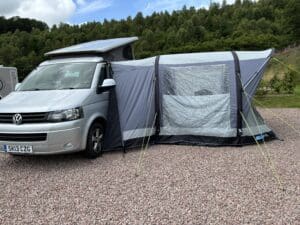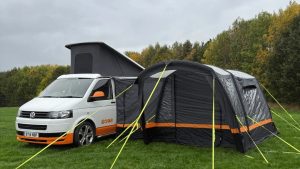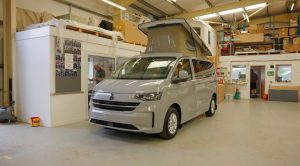
We last wrote about reclassifying your panel van or van with windows to a motor caravan in October 2020. At this point the DVLA insisted that your vehicle internally must have permanent features of seats, table, sleeping accommodation, cooking and storage facilities and that externally the campervan must have permanent features of; two or more rear windows, an access door into the living accommodation, campervan/motorhome decals, an awning rail on both sides and a fixed high top roof (yes that excludes pop top roofs!!)
However, on the 20th of October 2026 the DVLA posted an update to their guidance on their requirements for reclassification and on their general guidance.

What the DVLA said in October 2026
To quote the DVLA:
“DVLA is required to record vehicle details for road safety and law enforcement. The DVLA body type is used for establishing vehicle appearance and identification and should not affect the insurance category of the vehicle nor have any effect on speed limits or legislative requirements. To change the body type of a vehicle, DVLA must be satisfied that the vehicle meets their policy for body types, which is that the body type information held on the vehicle record must describe what a vehicle looks like in traffic.
It is important to remember that even if the vehicle’s body type is not changed to ‘motor caravan’, the vehicle can still be used for this purpose as long as the keeper is satisfied the converted vehicle meets the required internal features for motor caravans.
It is the responsibility of the vehicle keeper to make sure that any alterations made to the vehicle do not compromise its safety. If you sell the vehicle at a later date, it is your responsibility as the registered keeper to demonstrate the conversion work has been safely completed.”
Will it affect my speed limits if my van isn’t reclassified?
As the DVLA clearly state in the text above, which was taken directly from their website in Oct 2026, it won’t. Although they don’t explain the reason why, it is down to The Motor Vehicles (Type Approval) (Great Britain) Regulations 1979, where vehicle definitions are given, upon which speed limits are based for the Road Traffic Regulation Act 1984, Schedule 6. Within this 1979 Regulation the definition of a motorcaravan is as follows; a motor vehicle which is constructed or adapted for the carriage of passengers and their effects and which contains, as permanently installed equipment, the facilities which are reasonably necessary for enabling the vehicle to provide mobile living accommodation for its users.
If your campervan or motorhome meets these criteria, and cannot carry more than 8 passengers, does not have an unladen weight of over 3.05 tonnes and is less than 12m long, then regardless of what Body Type the DVLA assigns to your van, you have a motorcaravan and you are legally allowed to drive at the speed limits of a regular passenger car – 60mph on a single carriageway and 70mph on a dual carriageway. If you do receive a speeding fine then challenge it immediately and cite these two regulations. You will be in the right. In January 2021 we posted a blog that explains the speed limit situation in more detail with links to the relevant legislation – updated speed limit blog soon to come!
Will I still be able to get insurance?
It’s a question that many people are rightly concerned about and the answer in most cases seems to be a simple yes. From feedback across the sector, cases where insurance have been refused because a van has not been reclassified by the DVLA as a motorcaravan, look like they are few and far between. Insurers appear to be taking a pragmatic view in that their level of risk isn’t affected and the overall value of the vehicle won’t change according to the Body Type. Now the DVLA have updated their advice, it is possible more insurers will begin looking for classification as Motor caravan
How do I get my panel van or window van reclassified?
If you would like to pursue reclassification process, then there are two key areas to focus upon – the external and the internal features. Both are detailed on the DVLA website and we’ve given the links below.
- 2 or more windows on at least one side of the main body (this does not include windows on the driver or passenger doors) to provide a reasonable amount of daylight into the living accommodation
- a separate door which provides access to the living accommodation of the vehicle (this excludes the driver and passenger doors); a window on this door counts as a separate window on the main body
- a high-top roof or pop-top elevating roof


Will a new professionally converted campervan be registered as a motor caravan?
Simple answer – it depends! Where a professional converter sources a brand new vehicle from a manufacturer and then converts it into a campervan then yes, it can be. The professional converter has to meet regulations such as having certified full Type Approval (by IVA, National Small Series or European Whole Vehicle) and the vehicle must be unregistered so that the application is the very first – if the converter is working on an already registered panel van or window van it’s possible that they won’t reclassify the vehicle as a motorcaravan.
This means that yes, converters such as ourselves and of course the VW California will have a DVLA Body Type of motor caravan on their V5’s from the first point of registration.
Does a refused reclassification actually matter?
Peace of mind over the clarity of speed limits is probably the greatest benefit. For buyers in the second-hand market there may also be an impact on residual value if the Body Type of motor caravan isn’t stated on the V5 ownership document.