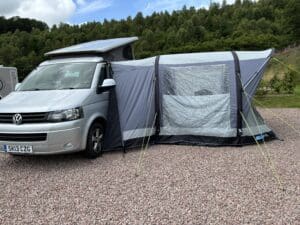
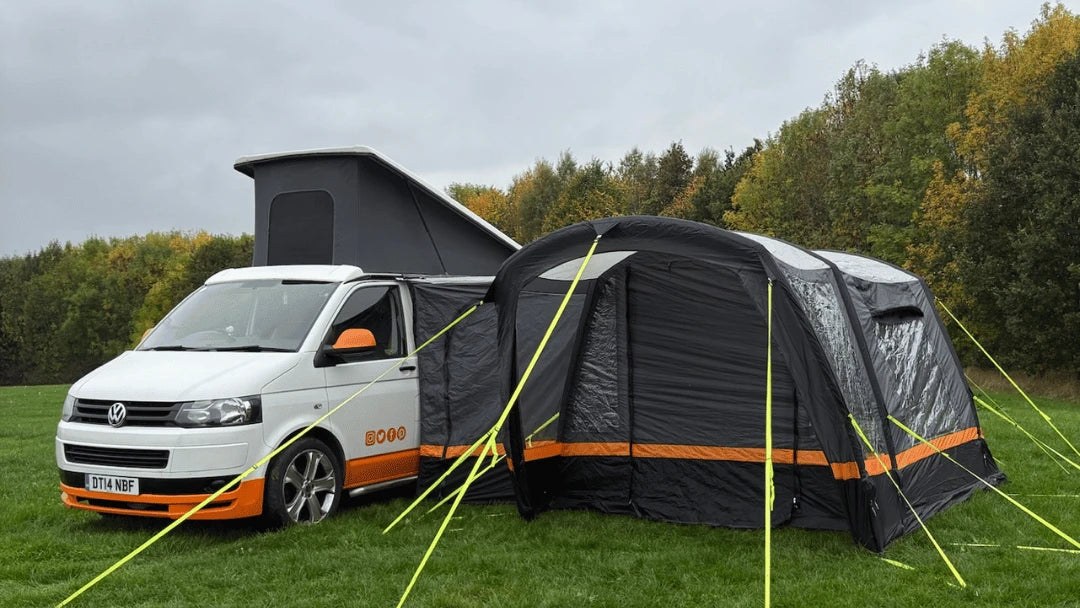
Quick answer: A drive away awning is a freestanding, tent-like room that connects to the side of your campervan or motorhome through a fabric tunnel. When you need the van, you unhook or unzip the tunnel and drive off, leaving the awning pitched on site to hold your pitch and keep your kit dry.
If you are new to campervan life, the name can be confusing. It is not an awning that comes with you when you drive. It is the one that stays behind. This guide explains how the tunnel actually meets your van, which attachment method suits which vehicle, and the honest downsides owners talk about.

How a drive away awning works
A drive away awning has two parts: a body that stands up by itself and a tunnel that links it to the vehicle. You detach the tunnel, drive off for the day and reattach it when you return. CamperNV’s guide to how a drive away awning works covers it step by step.
The freestanding body
The main room is held up by poles or inflatable air beams and pegged to the ground like a tent. It has its own doors, windows and usually a groundsheet, so it stays upright and weatherproof without the van beside it.
The connecting tunnel
The tunnel, sometimes called a sleeve or cowl, is the fabric section that seals against the side of your van. When you leave, you zip the awning shut, release the tunnel and drive away. Your chairs, table and muddy boots stay dry, and other campers can see the pitch is taken.
Drive away awning vs fixed and wind-out awnings
With a fixed awning, the side of the vehicle is the fourth wall, so the awning has to come down before you can move. A wind-out awning is a cassette on the roofline that gives shade and light rain cover, but no enclosed room.
| Option | Pros | Cons | Best for |
|---|---|---|---|
| Drive away awning | Enclosed room, stays pitched when you leave | Cost, pitch time, needs a fitting method | Stays of two nights or more |
| Wind-out awning | Seconds to deploy, always on the van | Shade only, no walls as standard | Overnight hops, day stops |
| Sun canopy | Light, cheap, packs small | Little weather protection | Summer trips |
| Gazebo | Cheap, flexible | Not linked to the van, poor in wind | Occasional use, budget |
| Tent beside the van | Very cheap, extra sleeping | No dry link to the van | Families on a budget |
How it attaches to your campervan or motorhome
For most buyers this is the deciding factor. The awning itself is the easy part; getting the tunnel to seal neatly to your van is where the choice gets made.
Awning rail and a driveaway kit
The most secure method is an awning rail fitted along the van. A driveaway kit uses a figure-of-eight strip (often called Kador or Keder): one side slides into the rail, the other into the awning’s beading channel. CamperNV’s driveaway kit guide covers the common 4mm and 6mm sizes, and its guide to attaching a drive away awning covers the no-rail options. If your van does not have a rail, see our awning rails, awnings and sunshades page.
Wind-out awnings
If you already have a Fiamma, Thule Omnistor or Dometic wind-out awning, its cassette usually has a channel you can feed a kit into. Many of these take 4mm beading, so a 4/6mm kit is a safe choice when you are not sure.
No rail fitted
There are workarounds if you have no rail:
- Magnetic strip: grips a steel roof edge, quick to fit.
- Suction limpets: cups on the bodywork with a ball and loop for the awning.
- Pole and clamp: clamps to a gutter, where your van has one.
- Throw-over straps: run over the roof and peg down on the far side.
- Roof bars: straps or Velcro around existing bars.
On a pop-top van, check where the roof meets the body before choosing a method, as the attachment point needs to sit below anything that lifts.
Low, mid or tall: getting the height right
Drive away awnings come in height bands based on the distance from the ground to your attachment point. Brands vary slightly, but these are the typical ranges (CamperNV’s drive away awning heights guide explains how to measure):
| Height band | Attachment height | Typical vehicles |
|---|---|---|
| Low | approx. 180 to 210cm | VW T6.1, T7, Ford Transit Custom |
| Mid | approx. 210 to 255cm | High-top vans, compact motorhomes |
| Tall | approx. 255 to 295cm | Coachbuilt motorhomes |
To measure, park on level ground and measure from the ground to your rail or fitting point at both ends of where the tunnel will sit. Use the higher figure. Pop-top and roof changes alter this, so measure your own van rather than relying on the model. Our VW T7 vs Ford Transit Custom comparison has more on how these two compare.
Air beam or poled?
Air beam awnings inflate with a pump, are usually quick to pitch and one person can manage it. They cost more and pack bulkier. Poled awnings are cheaper, and a bent pole is easy to replace, but pitching takes longer. CamperNV’s air awning vs poled awning guide sets out the trade-off in more detail. Owners on the VWT4 Forum say air beams take away the faff of matching pole heights, though the pump is one more bulky item to carry.


What owners like about them
Across the UK forum threads we reviewed, owners return to the same benefits:
- Keeping your pitch while you are out exploring.
- Storage for bikes, chairs and wet gear, freeing space inside the van.
- Extra living or sleeping room, with inner bedroom pods available on many models.
- A dry link to the van, valued for privacy and poor weather.
The downsides owners report
The same discussions are honest about the drawbacks. These come from third-party owners on the UK Campsite forum and the VWT4 Forum, not from our own testing:
- Water pooling in the tunnel. Several owners say the tunnel can sag and collect rain in long downpours; some push it up from inside or disconnect it in heavy rain.
- Flapping in wind. The tunnel can billow and is hard to tension.
- Lining the van back up. Reversing to the right distance after a day out takes practice.
- Fiddly kits. Some find feeding a figure-of-eight strip awkward and prefer straps or a pole and clamp.
- Air pressure. Air beams can soften when the temperature drops overnight, so owners top them up.
- Draughts. Heat can escape through the tunnel when doors are open.
- The next van. An awning bought for one height may not suit your next vehicle.
What does a drive away awning cost?
Prices vary with size, frame and brand. As a rough guide from UK retailers and owner reports in October 2026:
- Poled models: from around £300.
- Low air models for campervans: roughly £550 to £750.
- Large or tall air models: around £900 to £1,500 or more.
Prices change with seasons and sales, so check current listings before you buy.
Is a drive away awning right for you?
A drive away awning makes most sense if you stay two nights or more and use the van by day. If you mostly move every night, a wind-out awning or sun canopy will be quicker. If you have a family or a dog, the extra room is hard to beat. For more pitching advice, read rookie errors and top tips for awning users.
Need a way to fit one? See our awning rail options, or browse drive away awnings from our commerce partner CamperNV.
Frequently asked questions
Can I fit a drive away awning myself?
Yes. Most are designed for one or two people to pitch, and air models are especially straightforward. Practise once at home before your first trip.
What is an inflatable (air) awning?
It uses air beams instead of poles. You inflate the beams with a pump and the awning takes shape in a few minutes.
Can you sleep in a drive away awning?
Yes, many models accept an inner bedroom pod, which adds sleeping space for children or guests.
What is better than an awning?
It depends on your trips. For quick stops a wind-out awning is faster; for budget extra space, some owners use a gazebo or a small tent beside the van.
Do I need an awning rail?
No, but it is the most secure option. Magnetic strips, straps, suction limpets and pole and clamp kits all work without one.